Somewhere in my mind, there’s a vision of a playroom that stays tidy for more than a single afternoon. You probably have your own version of it too. You know…the one where the bins are labeled, the shelves are curated, and the floor isn’t a minefield of tiny plastic surprises. But if you’ve ever tried to create that space in real life, you already know the truth that it never lasts. And it’s not because you’re disorganized. It’s because most playrooms are designed in ways that work against how kids actually play.
After years of crafting, parenting, and helping families rethink their creative spaces, I’ve learned something that changed everything: playrooms don’t fail because we’re messy. Nope, they fail because they’re designed wrong. And the fix has nothing to do with prettier bins or stricter cleanup rules.
If you’ve been caught in that same loop of the hopeful reset followed by the inevitable chaos, you’re in good company. The problem isn’t your effort. It’s the way traditional playroom organization ignores how children naturally explore, create, and make a mess with purpose.
And that’s the part most organizing advice gets wrong.
The Myth of the Organized Playroom
Most playrooms are designed like mini adult offices:
- bins for every category
- shelves lined with matching containers
- toys sorted by type, size, or theme
- a “home” for everything
It looks great in photos. It feels satisfying in the moment. But it’s built on an assumption that kids will use the space the way adults wish they would, one toy at a time, neatly returned before the next one comes out.
That’s not how children play.
Kids dump to see what’s at the bottom. They mix categories because their imagination doesn’t care about your labels. They follow impulses, not systems. And when a space fights their instincts, the space always loses.
Organizing Fails When There’s Too Much Stuff
You can’t organize excess.
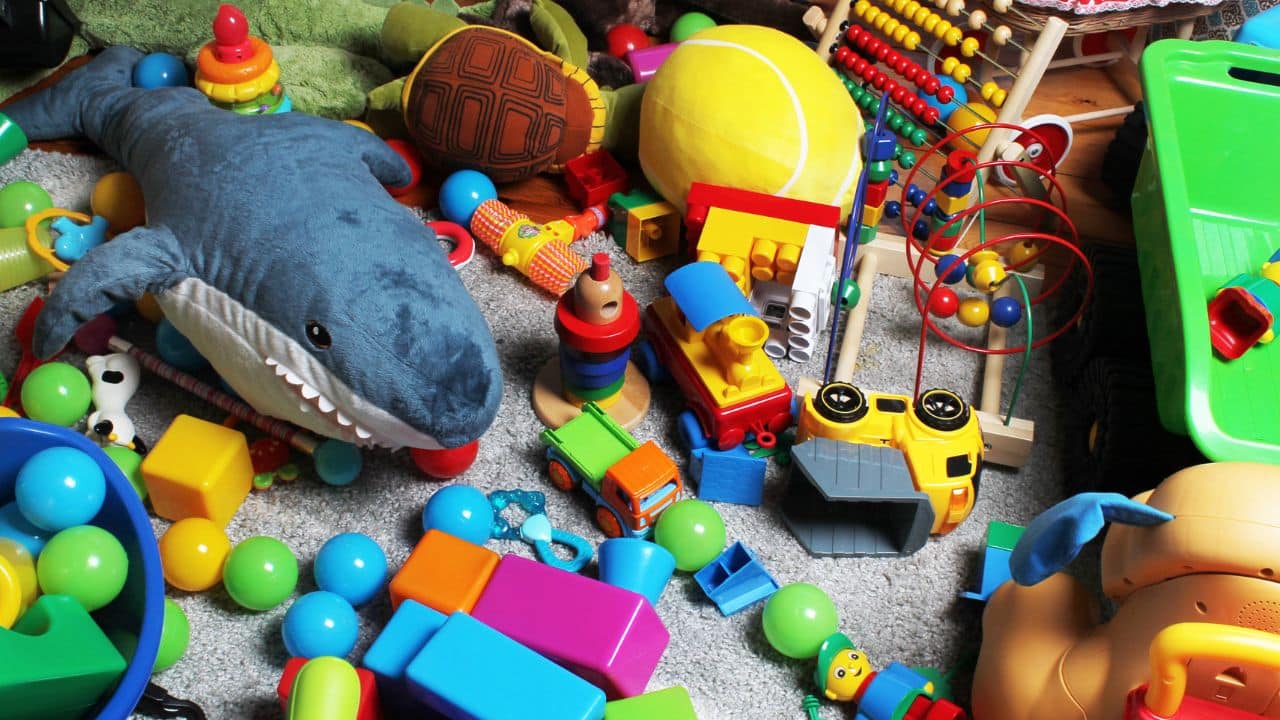
Even the best system collapses under volume. A playroom with 200 toys will always feel chaotic, no matter how beautifully it’s organized.
In reality, most playrooms simply hold more toys than a child can realistically use.
When every shelf is full, and every bin is packed, no system can function long-term. Children simply can’t put things away easily, and parents end up constantly resetting the room.
Decluttering is not optional. In fact, I’d argue that it’s foundational.
Until the volume is reduced, the organization will always feel temporary.
There’s No Clear Plan for How the Space Is Used
A common mistake is organizing without deciding *how* the playroom is supposed to function.
Is it for: quiet play, active movement, crafts, open-ended building, pretend play?
When everything lives together without intention, toys compete for space and attention. Organizing by category alone doesn’t work if the room doesn’t support the way a child actually plays.
A plan always needs to come before bins.
The Space Is Designed for Aesthetics, Not Function
Pretty containers, matching baskets, and rainbow labels are fun for us. Kids care about access, visibility, and ease.
Many organizing systems make sense to adults, but not to kids. Perfectly labeled containers, matching bins, and hidden storage look tidy, but they often require:
- multiple steps to clean up
- strong sorting skills
- adult-level memory and impulse control
When a system is too complex, children stop using it. Parents then end up managing the organization themselves, which defeats the purpose.
If a child can’t put things away independently, the system will fail.
Everything Is Organized, So Nothing Is Prioritized
When every toy has equal space and visibility, nothing stands out. Open shelving invites dumping.
A wall of bins looks tidy… until a child pulls out every single one to find the one thing they want. It’s inefficient.
Children play better when options are limited. Over-organized rooms often display everything at once, which leads to decision fatigue, shallow play, toys being dumped instead of used intentionally.
Adults love micro‑sorting. Kids don’t. If a child has to decide whether a plastic dinosaur belongs in animals, small figurines, pretend play, or things with legs, they’ll skip the decision entirely and drop it on the floor.
Fewer toys, thoughtfully displayed, encourage deeper engagement than perfectly organized abundance.
The Room Isn’t Allowed to Evolve
Children grow quickly, but playrooms often stay frozen in one stage.
Kids grow, their interests shift, and their play becomes more complex, but many playrooms stay frozen in the age they were first designed. A toddler‑friendly setup doesn’t serve a preschooler. A preschooler’s pretend‑play stage doesn’t match a budding builder or crafter.
Organizing fails when it’s treated as a one-time project instead of an ongoing adjustment.
What to Do Instead
Start with decluttering, not organizing
Remove broken toys, duplicates, and items that no longer match your child’s interests. Keep less than you think you need…much less.
Observe how your child actually plays: Watch for patterns: dumping, lining up, building, pretending. Design storage that supports those behaviors instead of trying to correct them. Be intentional.
Choose simple, forgiving systems: Open baskets, shallow bins, and visible storage work better than rigid sorting. One-step cleanup is the goal.
Rotate instead of storing everything: Toy rotation reduces clutter without getting rid of everything. Fewer options lead to better play and easier cleanup.
Accept an intentionally messy look. A functional playroom doesn’t stay pristine. Signs of ongoing play mean the space is working.
The Real Goal of a Playroom
In the end, most of us don’t really want a magazine‑ready playroom. We just want a space our kids can actually use without it turning into a disaster zone by Tuesday.
And the truth is, once you stop chasing the perfectly organized room and start building a flexible, kid‑driven one, everything (the play, the cleanup, the energy of the whole space) gets easier.
Your playroom doesn’t need a total overhaul. It just needs permission to evolve, simplify, and work for the real humans who live in your house. When you design with that in mind, the room finally supports your family instead of fighting against it. And honestly, that’s the kind of organization that actually lasts.

Thalia Mercer is a creator and writer. She shares easy craft ideas and creative activities designed to support learning, exploration, and everyday creativity at home. She is mama to a young son and loves finding small moments of expressiveness in ordinary days.